Guide to Calm, Clutter-Free Homes
ol > li {
position: relative;
padding-left: 25px;
margin-bottom: 10px;
counter-increment: item;
}
ol > li::before {
content: counter(item) “. “;
position: absolute;
left: 0;
}
.toc-container {
border: 1px solid #e5e5e5;
padding: 20px;
border-radius: 12px;
background: #fafafa;
margin: 20px 0;
}
.blog_content_con div {
margin-bottom: 5px !important;
}
.blog_content_con p {
margin: 0 0 6px 0 !important;
}
Minimalist interior design focuses on creating calm, clutter-free homes through purposeful furniture, smart storage, balanced layouts, and neutral colour palettes. For urban homes in Mumbai and Bangalore, it helps maximise available space without sacrificing comfort or personality. Using multifunctional furniture, durable materials, concealed storage, and thoughtful room planning can make even compact homes feel spacious and organised.
Walk into most Mumbai apartments, and you’ll spot the same problem: a 650 sq ft 1BHK trying to hold a dining table, a study corner, a TV unit, and enough storage for a family of four. Bangalore homes get more square footage, but WFH setups, pooja corners, clutter in open kitchens, and festival decor pile up just as fast. Minimalist interior design has become the go-to answer for both cities, as it perfectly solves the space problem without compromising on aesthetics.
What Is Minimalist Interior Design?
Minimalist interior design is often misunderstood. It isn’t about owning less for the sake of it, but about purposeful furniture, uncluttered layouts, and a home where every piece earns its spot. A compact Mumbai flat and a spacious Bangalore villa need different solutions. Still, the underlying logic of modern minimalist interior design stays the same: keep anything that functions or holds real meaning, while letting go of what’s just taking up space.
Core Characteristics of Minimalist Design
This is what separates minimalist style from a room that looks empty:
- Functionality: Functionality drives every choice here, so a console table doubles as shoe storage, and a bed frame often hides drawers underneath.
- Visual Balance: Visual balance matters too, since mismatched proportions feel chaotic no matter how few items are in a room.
- Purposeful choices: Décor stays restrained but not absent, and every detail, down to a switch plate, is chosen on purpose rather than picked up because it was available.
How to Choose a Minimalist Colour Palette
White walls alone tend to backfire, especially in Mumbai homes where humidity and pollution leave visible marks within a year. This layered approach to minimalist style interior design is what keeps a neutral home from feeling flat:
- Warm whites, beige, taupe, and soft grey hold up better and reflect light more gently, which is important in homes that have access to natural sunlight.
- Taupe and warm greys also hide scuff marks near doorways and switchboards, useful in high-traffic homes with kids and pets.
- In Bangalore, where natural light stays softer through the year, muted sage or clay tones work well against larger window walls.
- Layer two or three tones from the same family, then bring in a single accent, like a mustard cushion or a terracotta pot, so the palette feels calming rather than dull.
Minimalist Materials, Furniture and Wall Finishes
- Matte finishes hide fingerprints and water spots better than gloss, worth knowing if your kitchen backsplash gets touched fifty times a day.
- Natural wood adds warmth and works well in both cities, though interior designers in Mumbai will always recommend moisture-resistant veneers over raw wood due to the city’s coastal humidity.
- Stone countertops handle daily cooking wear, glass partitions keep compact layouts feeling open, and metal accents on handles or lighting add edge without cluttering the visual field.
- Furniture with clean profiles and concealed storage does double duty in urban Indian homes, where a shoe cabinet by the door or a storage ottoman in the living room quietly solves the clutter that builds up from daily use.
Minimalist Design Ideas for Every Room
- Living Room: One statement sofa instead of mismatched seating pieces, with a low-profile console that hides remotes, chargers, cables, and festival decorations when not in use.
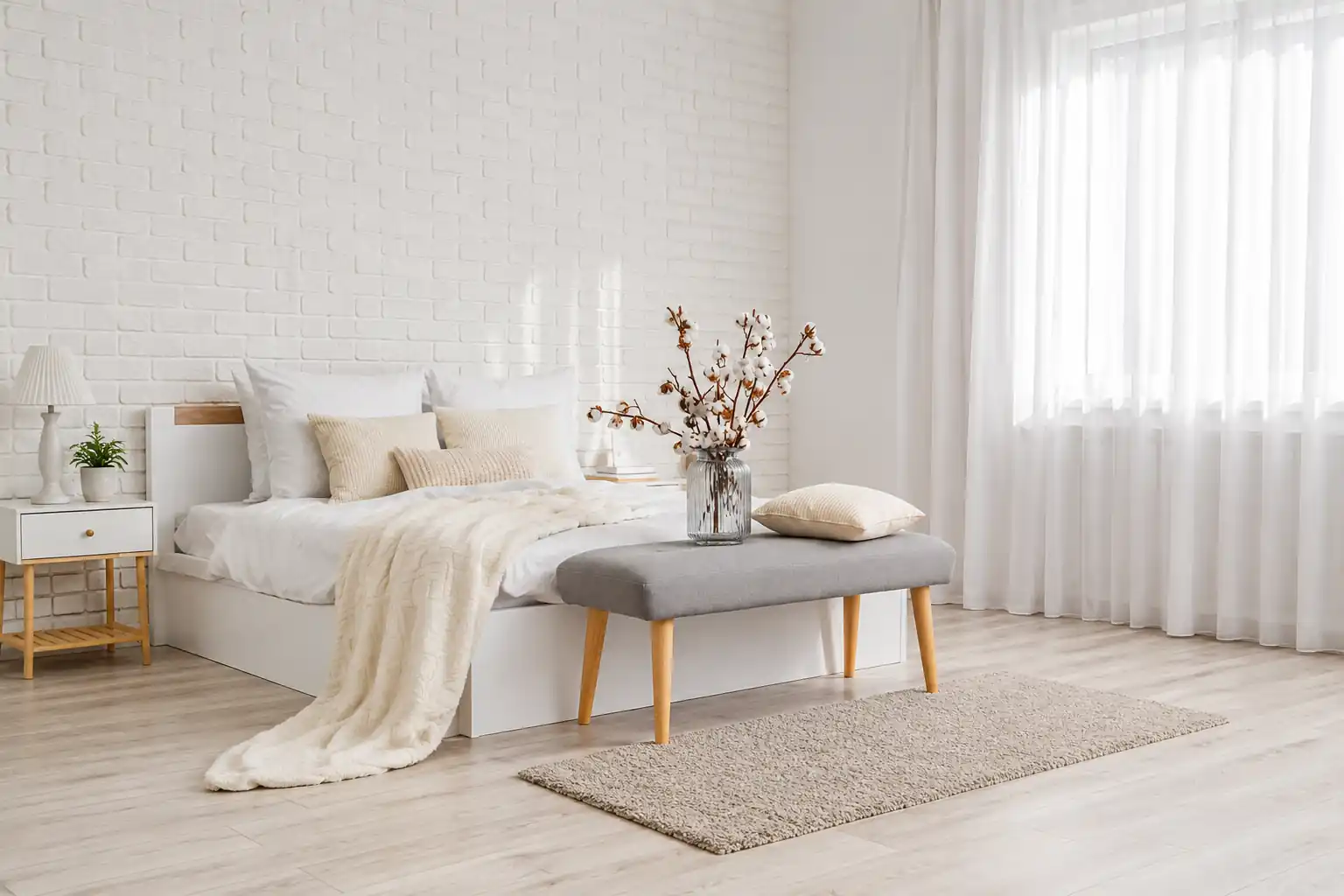
- Bedroom: A platform bed with under-storage, a single bedside table, and a wardrobe layout planned around actual daily use. Ensure that the walkways remain free at all times.
- Kitchen: Handleless cabinetry and a closed pantry unit keep counters clear, which matters most during the morning rush when three people get ready for school and office at once.
- Bathroom: Wall-mounted fittings and a recessed storage niche make even a 4×6 ft Mumbai bathroom feel less cramped. Avoid adding overly large buckets or bathtubs if your bathroom lacks adequate space.
How to Create a Clutter-Free Home Without Losing Personality

Clutter usually collects in the same few spots: the entryway where shoes pile up, the kitchen counter where appliances multiply, and the study table where a child’s books and stationery spread out. Planning dedicated storage for each of these zones solves most of the visible mess. Personality doesn’t have to disappear in the process.
A shelf with three framed family photos says more than ten random knick-knacks spread across the room. And when festival season arrives, whether it’s Diwali diyas or Ganesh Chaturthi, a labelled storage box ensures that your décor comes out for a week and then goes right back in without cluttering your shelf all year round.
Common Minimalist Interior Design Mistakes to Avoid
Clearing out too much furniture leaves a room feeling hollow instead of calm. Relying only on white without texture or layered lighting can feel cold, especially under a single harsh tube light rather than warmer, layered fixtures that soften a room in the evening.
Skipping proper storage planning is the biggest mistake, since even a well-planned modern minimalist interior design falls apart if there’s nowhere to store daily items. Another major mistake is buying furniture that looks good in pictures but feels uncomfortable to use. Make sure that any item you install in your house is not only usable, but also useful for your day-to-day routine.
How Bonito Designs Creates Minimalist Homes
At Bonito Designs, modern minimalist interior design is planned around how you and your family actually live, not around a template that follows popular internet trends. Our LifeDesign philosophy starts with your daily routines, from school-morning rushes to where your pet loves to sleep; each aspect of your day-to-day life is considered before any design decisions are made.
With in-house execution, ISO-certified quality checks, and years of experience with Mumbai’s compact layouts and Bangalore’s independent homes and gated communities, we manage the entire journey from design to build, quality checks, and handover under one roof.
If you’re planning a minimalist home that actually works for how you live, get in touch with Bonito Designs for a consultation.
PakarPBN
A Private Blog Network (PBN) is a collection of websites that are controlled by a single individual or organization and used primarily to build backlinks to a “money site” in order to influence its ranking in search engines such as Google. The core idea behind a PBN is based on the importance of backlinks in Google’s ranking algorithm. Since Google views backlinks as signals of authority and trust, some website owners attempt to artificially create these signals through a controlled network of sites.
In a typical PBN setup, the owner acquires expired or aged domains that already have existing authority, backlinks, and history. These domains are rebuilt with new content and hosted separately, often using different IP addresses, hosting providers, themes, and ownership details to make them appear unrelated. Within the content published on these sites, links are strategically placed that point to the main website the owner wants to rank higher. By doing this, the owner attempts to pass link equity (also known as “link juice”) from the PBN sites to the target website.
The purpose of a PBN is to give the impression that the target website is naturally earning links from multiple independent sources. If done effectively, this can temporarily improve keyword rankings, increase organic visibility, and drive more traffic from search results.
Related Posts
10 Kitchen Lighting Ideas to Transform Your Cooking Space
10 Best Bedroom Sofa Design Ideas